
The Hidden Costs of Vibe-Coded Apps (What You Don't See Until It's Expensive)
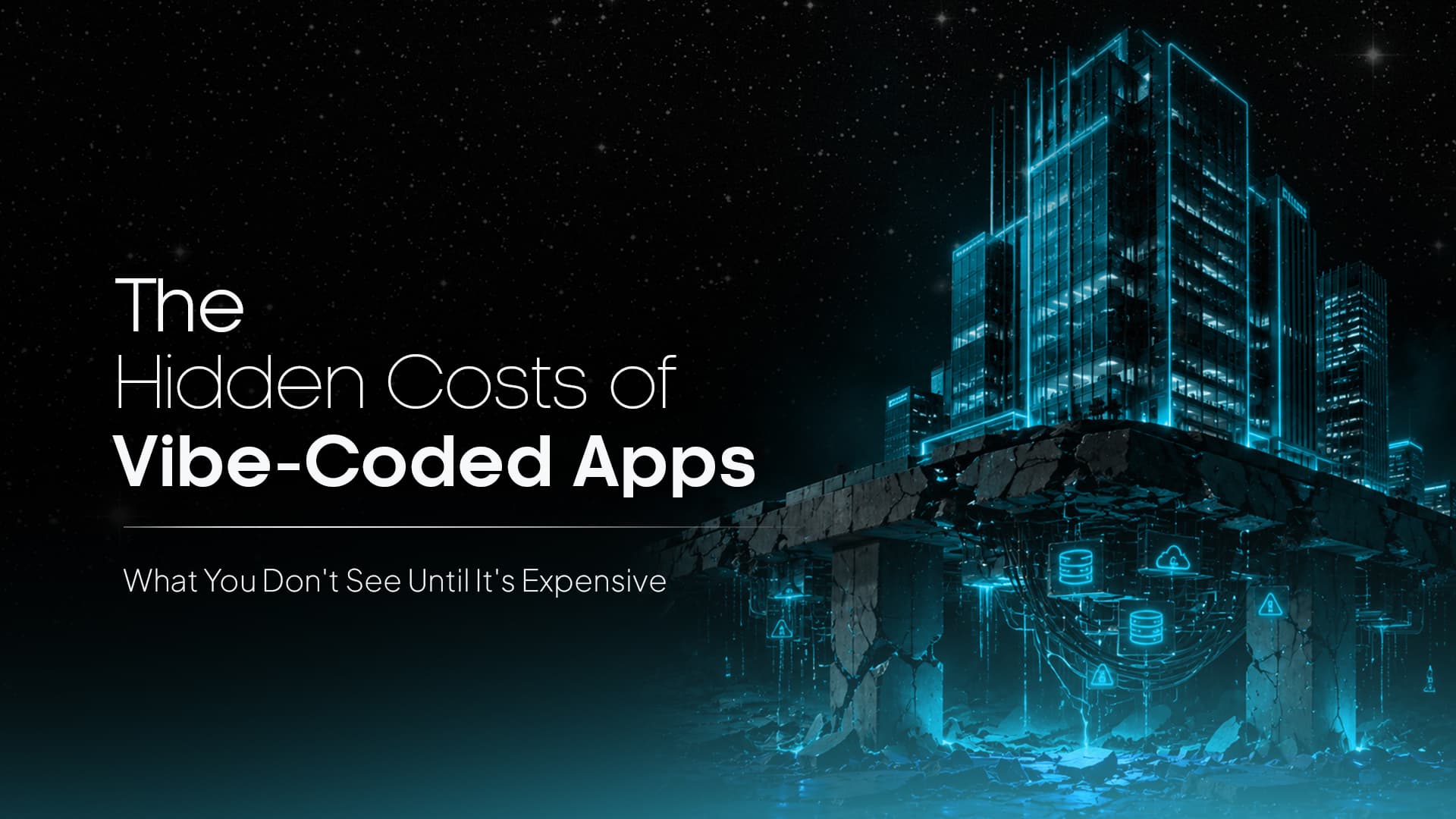
Vibe coding made software feel free. You describe what you want, the AI writes it, and a working app appears in an afternoon. No sprint planning, no architecture meetings, no waiting on a development team. For a founder watching an idea turn into a live product in three weeks, it looks like the cost of building software has finally dropped to zero. It didn't drop. It moved. The cost of a vibe-coded app doesn't disappear; it relocates to month three, month six, or the day a paying customer's data leaks. And by the time it shows up, it's larger than it would have been if it had been paid upfront. That's the pattern researchers and engineering teams have been documenting through 2026, and it has a name now: the ninety-day reckoning. This piece breaks down exactly where that cost hides, what it's measured to cost in real numbers, and how to tell if your own app is already carrying it.
What “Vibe Coding” Actually Means
Vibe coding is not the same thing as using AI to write code. It's a specific approach where decisions get made based on whether the output feels right in the moment, rather than through architectural planning, data modeling, or a review of long-term system behavior. The developer's role shifts from writing code to directing an AI and accepting what it produces, often without reading it closely enough to know what it actually does.
In the early stage, this looks like pure progress. The problem is that it's deferred thinking, not eliminated thinking. Every architectural decision the process skips still needs to get made eventually. Vibe coding just moves that decision to a point where it's far more expensive to make.
The Rescue Math
Here's where the abstract cost becomes a concrete number. By the end of 2025, roughly 10,000 startups had used AI coding tools to build production applications. By the middle of 2026, more than 8,000 of them needed either a partial rebuild or dedicated rescue engineering to keep operating. The average cost of that rescue work runs between 50,000 and 500,000 dollars, depending on how far the application had grown on top of its original, unreviewed foundation.
The gap between those two numbers is the story. A 50,000-dollar fix applies to a small app with a clean data model and no security incident, one that a developer can extend rather than rebuild from scratch. A 500,000-dollar fix applies to an app that's been live for eighteen months, built on a data model that can't be migrated without risking real data loss, with security issues serious enough to require formal incident response as part of the work. The application didn't get eighteen months better in that time. It got eighteen months harder to fix.
Compare that against the cost of building on deliberate architecture from day one, where schema decisions, access controls, and security review are part of the build rather than an afterthought bolted on after a breach. The rescue number is what you pay for skipping that step. It is not a discount. It's the same work, done later, under pressure, with real users and real data already in the system.
Self-Check: Is Your App Already At Risk
You don't need a security background to run a basic diagnostic on your own app. A few honest answers will tell you where you stand.
Does your app have an automated test suite, or does “it worked when I clicked it” count as testing? No tests mean no safety net, and every future change becomes a gamble on what silently breaks somewhere else. Do you know whether your database has row-level access controls turned on, or did you never touch that setting because the app worked without it? Missing access control is the single most common vulnerability found across vibe-coded apps in production scans.
Are there functions in your codebase that work, that everyone agrees work, but that nobody on your team can explain? That's comprehension debt, and it's a sign the codebase has already outgrown anyone's understanding of it. Has anyone checked whether API keys or credentials are hardcoded into the source rather than stored securely? Exposed secrets show up in a meaningful share of AI-generated repositories precisely because it's the fastest path to “it works” during a prompt session.
If you answered yes to more than one of these, the debt isn't a future risk. It's already sitting in production.
When Vibe Coding Is Fine, And When It Isn't
None of this is an argument against vibe coding as a tool. For a prototype, an internal tool nobody outside your team touches, or a pre-revenue product built purely to validate an idea in front of early users, the speed is a genuine advantage, and the risk is contained, because there's no real user data and no real money moving through the system yet.
The line moves the moment any of three things happen: the app starts handling real user data, it starts processing payments, or it moves past validation into a product people are actually paying for and depending on. At that point, the trade-off changes completely. The cost of a breach, in customer trust, regulatory exposure, and the engineering work to identify and notify affected users, is almost always larger than the cost of building it correctly would have been. That's the point at which deliberate architecture stops being a nice-to-have and becomes the only responsible option.
What a Custom Development Approach Changes Structurally
The difference isn't that a development team writes code more slowly on purpose. It's that certain decisions are made deliberately rather than by default. Database schema and indexing are designed around how the app will actually be used, not generated anew for each feature request.
Access control and row-level security get configured as part of the build, not discovered missing after a scan finds them exposed. Code gets reviewed by someone who understands the full system, not just the person who wrote the last prompt, which is what closes the gap between code that works and code that's actually safe to run.
This is the exact gap a custom software development agencyexists to close. It's not about rejecting AI-assisted development; most modern teams use AI as part of their workflow now. It's about pairing that speed with the architectural ownership and security review that a fast, ungoverned build skips by default.
This is where TechBinariesoperates: taking a vibe-coded MVP that has outgrown its foundation and rebuilding the parts that matter, the data model, the access control, the pieces of the system nobody currently understands, without discarding the product validation that already happened. The goal isn't to redo the work from scratch. It's to give the app the structure it should have had from day one, so the next feature doesn't come with a hidden cost attached.
For a founder deciding whether to keep building on a vibe-coded MVP or bring in a team to structure it properly, that's the actual question: not whether AI helped build the app, but whether anyone with the right expertise reviewed what it built.
The Real Choice Isn't Speed vs. No Speed
The choice was never between building fast with AI and building the traditional way slowly. It's between paying for structure upfront, while the codebase is small and the fix is cheap, or paying for it later, when the codebase is large, the users are real, and the fix comes with an incident report attached. Vibe coding doesn't remove that cost from the equation. It just decides, by default, when you pay it.
If your app has grown past the prototype stage and you're not certain what's underneath it anymore, that's usually the moment to have someone qualified take a real look, before the ninety-day reckoning turns into a rescue project.